
informational 6 min read
History of the Paris Catacombs: Why They Were Built
Updated October 27, 2026
The Paris Catacombs were built because two crises met underground at the end of the 18th century: the limestone quarries beneath the Left Bank were caving in, and the cemeteries of the city centre were overflowing. The city reinforced the old quarry tunnels and, from the late 1780s, moved the dead into them. Arranged into an ossuary from 1810, the Catacombs have been open to visitors since 1809 and today form one of the City of Paris museums.
Why were the Paris Catacombs built?
Much of the Left Bank stands on Lutetian limestone, the stone that built much of Paris. It was mined by digging shafts down to the deposit and quarrying sideways until it ran out, often without records, so by the 18th century parts of the growing city sat over forgotten voids.
In 1774 a house on the rue d’Enfer, near today’s Avenue Denfert-Rochereau, collapsed into an old quarry. King Louis XVI set up a commission to survey the underground, which became the Inspection générale des carrières, the general inspectorate of quarries. Its engineers began shoring up the tunnels with masonry passages under the streets.
At the same time the Holy Innocents’ Cemetery, beside the market of Les Halles and in use for centuries, had become a mound of earth about two metres high. In 1780 a basement wall next to it collapsed under the weight of the mass grave behind it. The cemetery was closed, burials within the city walls were banned, and the question of where to put the dead was handed to the same police authority overseeing the quarries.
When were the Paris Catacombs built?
The decision to use the reinforced Tombe-Issoire quarry passages as a sepulchre became law in 1785. A well was dug from a walled property above the tunnels, near the Barrière d’Enfer, the “Gate of Hell” on the old customs wall. From the late 1780s, covered wagons draped in black carried remains there from the Innocents by night. Emptying most of the city’s cemeteries took about two years, and later transfers continued.
Remains came from the Innocents, by far the largest with about two million burials over six centuries, and from cemeteries including Saint-Étienne-des-Grès, the Madeleine, Notre-Dame-des-Blancs-Manteaux and Errancis, which had been used for victims of the Revolution. That is how the remains of Danton, Robespierre, Lavoisier and others ended up in the ossuary, mixed with everyone else’s.
Who built the Paris Catacombs?
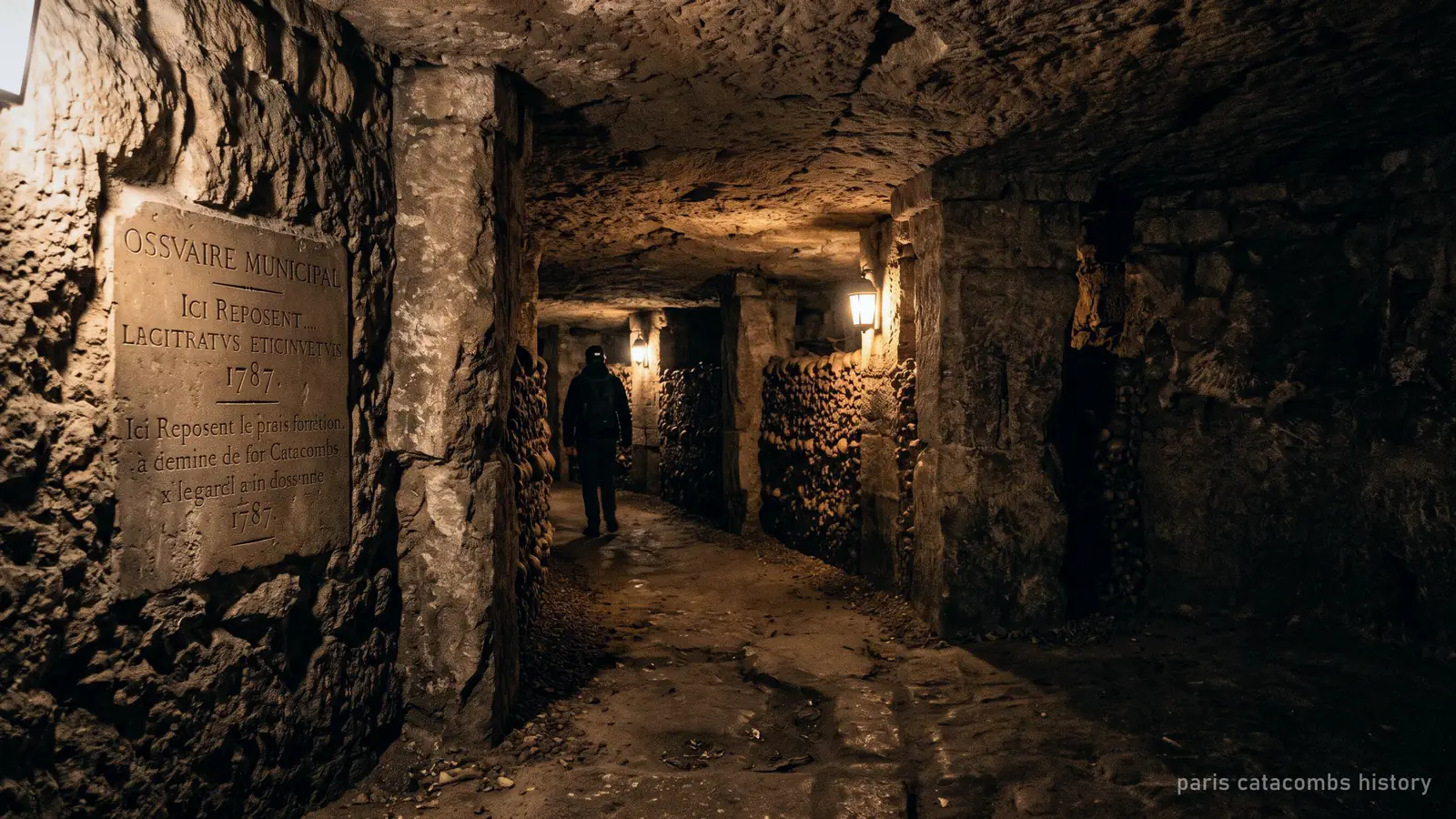
Three groups did. Generations of quarrymen dug the galleries. The quarry inspectorate reinforced them and organised the transfers. And Louis-Étienne Héricart de Thury, director of the inspectorate from 1810, turned what was a disorderly bone store into the ossuary visitors walk through: skulls, femurs and tibias stacked into walls and patterns, headstones and monuments recovered from the old cemeteries, and tablets with warnings and verses, including the inscription at the entrance gate, “Stop! This is the empire of Death.” He also walled the ossuary off from the rest of the tunnel network to keep visitors safe.
When did visits begin?
The ossuary drew curious visitors almost from the start; the Count of Artois, the future Charles X, went down in 1787. The City of Paris dates regular visits from 1809. Access swung between permission-only visits and closures in the following decades, until monthly and then twice-monthly openings from the 1860s and 1870s gave way to the daily visits of today.
The Catacombs in the 20th century
During World War II, members of the French Resistance used the tunnel network, and Colonel Rol-Tanguy led the 1944 insurrection for the liberation of Paris from a command post underground. The avenue where the Catacombs entrance now stands carries his name. In 2013 the Catacombs became one of the City of Paris museums managed by Paris Musées.
The 2026 renovation
A renovation programme that began in 2023 ended with a closure from November 2025 and a reopening on 8 April 2026. It replaced the air handling, with continuous monitoring of temperature, carbon dioxide and humidity, redesigned the lighting and fire safety, and introduced a new route and an audio guide narrated in the voice of Héricart de Thury. Restoration work also covered bone walls such as the one holding victims of the September Massacres of 1792.
See it for yourself
The history is told along the route by the audio guide on every entry ticket. If you want a historian to tell it in person and open gates the standard route passes, the restricted access tour is the best rated way to do it.
Frequently asked questions
Why were the Paris Catacombs built?
To solve two problems at once: the old stone quarries under the Left Bank were collapsing, and the city's cemeteries were overflowing. The reinforced quarry tunnels became the place to move the dead.
When were the Paris Catacombs built?
The ossuary was created in the late 1780s, when nightly convoys began moving remains from the Holy Innocents cemetery into renovated quarry tunnels. It was arranged into the visitable ossuary from 1810.
Who built the Paris Catacombs?
The tunnels were dug by quarrymen over centuries. The ossuary was created by the city's quarry inspectorate, and Louis-Étienne Héricart de Thury, its director from 1810, gave it the arranged walls of bones and inscriptions seen today.
Is anyone famous buried in the Catacombs?
Remains of several figures of the French Revolution were moved there from cemeteries such as Errancis and the Madeleine, Danton, Robespierre and Lavoisier among them, but bones were not kept separately, so no individual can be visited.
Sources